Oral health does not depend only on having beautiful teeth or correcting a specific discomfort. In many cases, patients present several problems at the same time: worn teeth, fractures, missing teeth, bite alterations or difficulties in chewing normally. When this happens, an isolated approach usually falls short and it is best to consider a complete solution.
Oral rehabilitation is precisely that comprehensive approach that seeks to restore function, comfort and esthetics to the smile. It is not just about replacing a tooth or improving dental appearance, but about analyzing how the teeth, gums, bite and temporomandibular joint work together to restore balance to the entire mouth.
In a clinic with personalized attention such as https://olivoodontologia.com/, this type of treatment focuses on understanding the specific needs of each patient, assessing the general state of their oral health and building a progressive plan that allows for functional, lasting and harmonious results.
Signs of wear, fracture or tooth loss
One of the main reasons to consider oral rehabilitation is the presence of visible or functional signs that indicate that the tooth structure is no longer working properly. Many times the patient becomes accustomed to the problem and only consults when pain, discomfort or difficulty eating becomes evident.
Among the most common signs are teeth with excessive wearfractured edges, weakened teeth due to extensive decay, missing teeth, frequent sensitivity, and changes in the way the teeth fit together when the mouth is closed. There may also be discomfort when chewing, a feeling that one side is working harder than the other, or difficulty pronouncing certain sounds.
In other cases, the patient notices that his or her smile has changed over time: shorter teeth, empty spaces, deteriorated old restorations or an aged appearance of the lower third of the face. These signs should not be seen only as an aesthetic issue, because they usually indicate that the mouth is losing functional stability.
When these signs are ignored, the problem can progress. A worn tooth can fracture more easily, a missing tooth can generate displacements, and an unstable bite can end up affecting muscles, gums and joints. Therefore, identifying these alerts in time allows us to intervene before the treatment becomes more complex.
How a bad bite affects oral health
The bite plays a central role in the health of the entire oral cavity. When the teeth do not fit together properly, the forces of chewing are poorly distributed and this produces an overload that over time can affect different structures.
A bad bite does not always cause immediate pain. Sometimes its effects appear progressively: irregular wear on certain teeth, repetitive fractures of resins or crowns, jaw tension, muscle pain, joint clicking or headaches related to functional effort. Some patients even consult initially for esthetic reasons, without knowing that behind the problem there is an occlusal alteration.
In addition, an unstable bite can promote plaque buildup in hard-to-clean areas, compromise gum health and make it difficult for previous treatments to last. If a patient has restorations without correcting the source of the imbalance, there is a risk that these solutions will fail sooner than expected.
That is why, within oral rehabilitation, bite analysis is not a secondary detail. It is an essential part of the diagnosis. Understanding how the teeth close, how the jaw moves and what the overload points are allows you to design a treatment that not only looks good, but actually works well.
Rehabilitation options on a case-by-case basis
There is no single approach to oral rehabilitation. The treatment depends on the number of teeth involved, the state of the gums, the bite, the patient’s expectations and the clinical objective to be achieved. That is precisely why it is considered a personalized process.
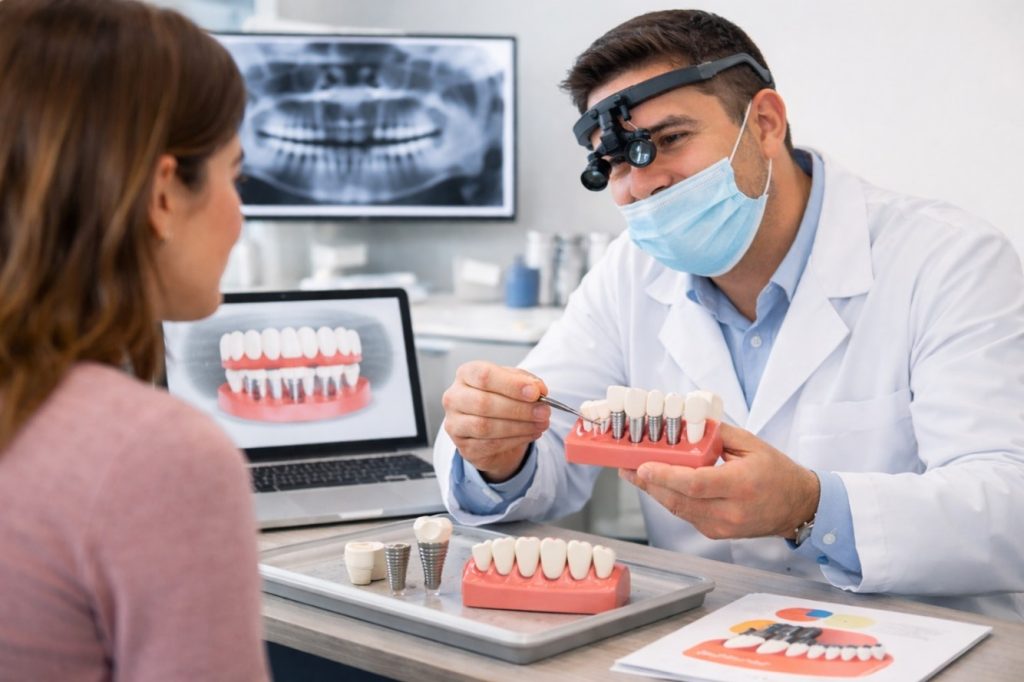
In mild to moderate cases, the plan may include resin restorations, inlays or crowns to restore shape, strength and anatomy to worn or fractured teeth. When tooth loss is present, dentures or dental implants may be considered. dental implants as part of a more stable and functional solution.
If the problem includes major bite alterations, support from other areas such as orthodontics, periodontics or endodontics may also be required. In some patients, the success of treatment depends on combining several specialties in an orderly sequence to restore health first and then functional and esthetic harmony.
The great advantage of this comprehensive approach is that it avoids improvised decisions. Instead of solving each tooth separately, a global plan is constructed. This makes it possible to predict results, take better care of the remaining tooth structure and achieve a rehabilitation that is consistent with the clinical reality of the patient.
Functional and esthetic benefits of oral rehabilitation
One of the most common mistakes is to think that oral rehabilitation is only related to the appearance of the smile. In reality, its greatest value lies in the fact that it improves essential day-to-day functions and, as a consequence, also transforms facial and dental esthetics.
From a functional point of view, this treatment can help to recover a comfortable and efficient chewing comfortable and efficient chewingIt can also improve pronunciation, eating comfort and the overall feeling of balance in the mouth. It can also improve pronunciation, comfort when eating and the overall feeling of balance in the mouth.
Aesthetically, oral rehabilitation restores length, shape, proportion and naturalness to the teeth. When the proper dimension of the bite is restored, even the face can look more harmonious and rested. This has a direct impact on personal safety and the way the patient relates socially.
Most importantly, esthetic results are not separate from health. A well-planned treatment aims to make the smile look good because it is structurally better, not because the problem has been made up. That is the difference between a superficial solution and a truly comprehensive rehabilitation.
Common cases treated in Envigado dental clinics
At dental clinics in Envigado, oral rehabilitation cases are often more common than many people imagine. They are not always older patients or extreme situations. Young adults with fractures, wear and tear due to bruxism, old missing teeth or restorations that no longer perform their function well are also consulted.
One of the most frequent scenarios is that of the patient who has lost one or more teeth and begins to notice that he or she is chewing on one side only. Another very common case is that of people with teeth worn down due to nocturnal clenching, who also present sensitivity, muscular discomfort or changes in the shape of their teeth.
There are also patients who arrive after several isolated treatments: resins, crowns, root canals or extractions performed at different times, but without a complete planning. In these cases, the mouth may be functionally disordered and require rehabilitation to reorganize the whole.
The approach in these contexts requires clinical expertise, careful diagnosis and an interdisciplinary vision. Olivo Odontología’s website offers specialized care, a close approach to the patient and a local presence in Envigado, valuable elements for patients seeking comprehensive dental solutions.
When comprehensive treatment is the best option
Oral rehabilitation becomes the best option when the problem can no longer be solved with an isolated intervention. If there is severe wear, repeated fractures, loss of several teeth, altered bite or a combination of functional and esthetic factors, it is best to perform a complete assessment and build a comprehensive plan.
It is also recommended when the patient feels that he or she has undergone several procedures, but still has not regained comfort, stability or confidence in smiling. This feeling of “temporary fixes” usually indicates that the case needs to be reviewed from a broader perspective.
Comprehensive treatment allows prioritizing needs, ordering clinical phases and projecting lasting results. Instead of improvising, we evaluate what should be done first, what can be preserved, how to protect the existing structure and what is the best sequence to restore balance to the mouth.
If you notice changes in your bite, frequent fractures, missing teeth or difficulty chewing, a professional evaluation can help you understand if you need a complete oral rehabilitation. To receive guidance and schedule an evaluation, you can contact us at https://olivoodontologia.com/#contacto and take the next step towards a more functional, stable and esthetic solution.